
Criminal Court Cases in Idaho County
Idaho County belongs to the Second Judicial District. Its District Court handles felony trials and sentencing, while the Magistrate Division handles misdemeanors, infractions, initial appearances, and preliminary felony work. District Judge Adam Green and Magistrate Judge Jeff Payne serve these distinct roles. Both divisions use the courthouse at 320 W. Main Street in Grangeville, so the building is shared even though the powers of each court differ.
The elected Clerk/Auditor is the record custodian. Kathy M. Ackerman's staff maintains filed papers, docket events, judgments, and certified copies. A police report does not become a court case merely because an arrest occurred. The prosecutor must file a complaint, information, or indictment. This distinction keeps an Idaho County court case lookup focused on judicial records rather than unfiled allegations or jail custody.
Two Idaho County Criminal Courts
Felony work can appear in both divisions. The Magistrate Division conducts the first appearance and may hold a preliminary hearing to decide whether probable cause supports moving the felony forward. The District Court receives the information, takes the arraignment, hears motions, and conducts a plea or trial. Misdemeanors and infractions generally remain with the magistrate.
| Court unit | Criminal role | Local access |
|---|---|---|
| District Court | Felony trial, judgment, and sentence | 320 W. Main, Grangeville; 208-983-2776 |
| Magistrate Division | Misdemeanors, infractions, felony preliminary process | Same courthouse and court line |
| Clerk/Auditor | File custody and certification | Room 5; 208-983-2751 |
| Idaho appellate courts | Appeals from trial-court rulings | State records through iCourt and the Supreme Court |
Idaho does not use a universal Class A, B, and C ladder. The offense statute controls the penalty, and iCourt usually displays the offense and statute rather than a generic class letter.
Idaho County Case Record Searches
Start with the Idaho iCourt Portal. Smart Search covers trial-court cases statewide. A complete case number is the strongest key; recent local numbers commonly resemble CR25-YY-NNNN, with 25 identifying Idaho County. A name search needs care because a shared name is not a confirmed identity.
- Open Smart Search and choose a record-number or name search.
- Enter the full case number, or use legal surname and first name. Test a former surname separately when relevant.
- Narrow results to Idaho County and criminal matters when those filters appear.
- Compare middle name, filing date, court, status, and other displayed details before selecting a result.
- Record the case number and ask the clerk for a missing image, paper copy, or certified document.
| Field label | Type | Required | Use |
|---|---|---|---|
| Search by | Tabs/control | One method | Record or Name |
| Record Number | Text | Alternative | Enter the complete number when known |
| Last Name | Text | Name search | Try legal and former names separately |
| First/Middle Name | Text | Middle is optional | Reduces false matches |
| County/Location | Filter | No | Select Idaho County when available |
| Case type/status/date | Advanced filters | No | Controls vary by portal view |
Idaho County Court Smart Search
The official iCourt interface is more than a name index. Its homepage also offers Search Hearings for a date range and a payment function. Public results can include the court, judicial officer, attorneys, charges, hearings, register of actions, outcomes, sentencing events, and balances. Yet a result page is only a window into the clerk's file.
The official Smart Search screen shows the controls a reader uses before opening a docket.
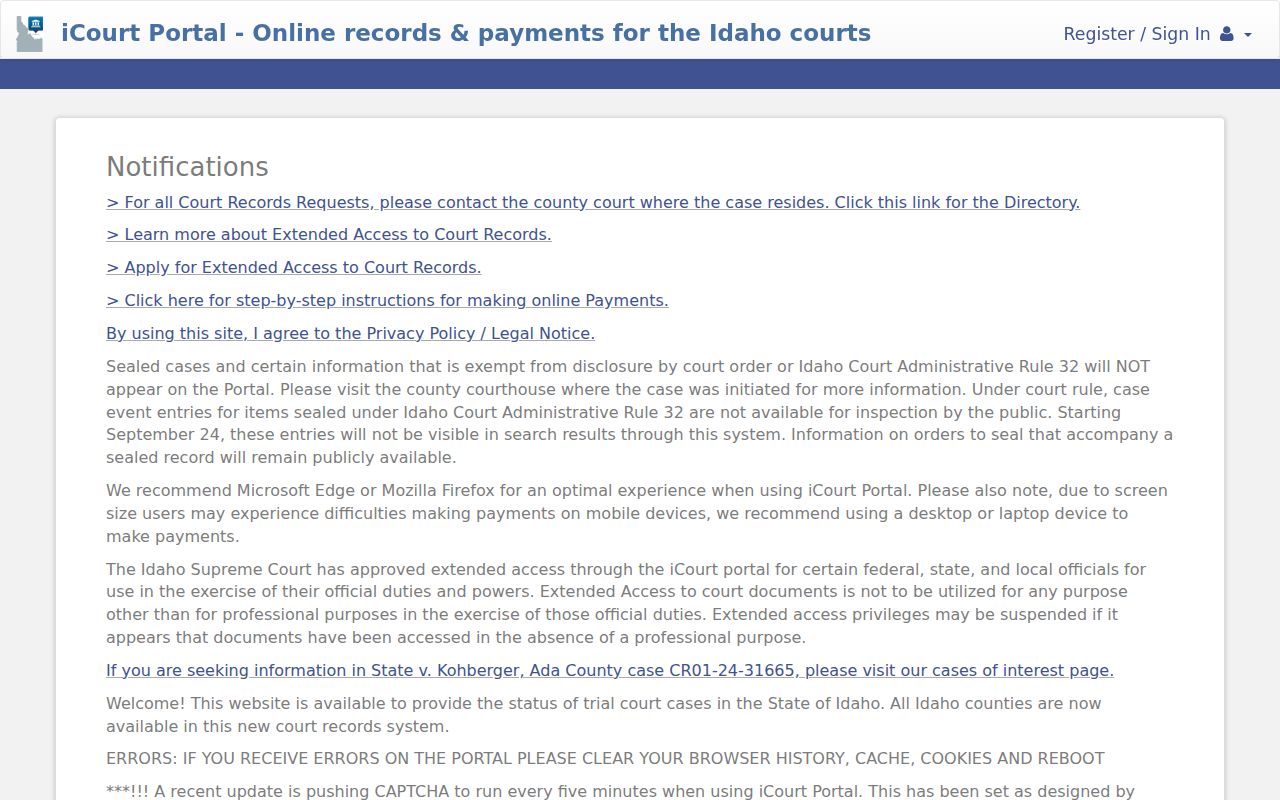
That interface helps locate a case number, but it does not guarantee that every document image is downloadable. CAPTCHA checks may recur, and the judiciary recommends a full desktop browser when mobile screens interfere.
Portal limit: Idaho Court Administrative Rule 32 keeps sealed cases and exempt information out of public search. A sealing order can remain public even when the sealed event is hidden.
What an Idaho County Case Contains
An Idaho County case file centers on one numbered prosecution. Read each count separately. One charge may be dismissed while another ends in a judgment, and a docket entry records an event rather than proving the allegation was true. The filed judgment and disposition supply the result.
| Case Number & Court | Local identifier, division, location, filing date, judicial officer, and status. |
|---|---|
| Charging Document | Complaint, information, or indictment stating the filed allegations and statutes. |
| Docket Entries | Chronological register of filings, notices, motions, orders, warrants, and hearings. |
| Hearing Dates | Past and scheduled events, subject to later court changes. |
| Disposition & Judgment | Outcome for each charge, such as dismissal, acquittal, conviction, or withheld judgment. |
| Sentence & Conditions | Custody, probation, fines, restitution, and other terms ordered by the judge. |
Exact birth dates, Social Security numbers, protected addresses, victim data, and confidential juvenile material are not public fields. The online view may also omit images that remain available from the clerk under applicable access rules.
Idaho County Court Counter
When a docket image is absent, take the case number to the clerk. The District Court page lists the courthouse at 320 W. Main Street, Grangeville, open Monday through Friday from 8:30 a.m. to 5:00 p.m., with the court line at 208-983-2776. Call first to confirm copy method and the current plain or certified-copy fee because the county does not publish a criminal-copy schedule.
Idaho County Court Clerk
320 W. Main Street
Grangeville, ID 83530
208-983-2776
Monday-Friday, 8:30 a.m.-5:00 p.m.
The local court page depicts the office that holds these Idaho County criminal case records.
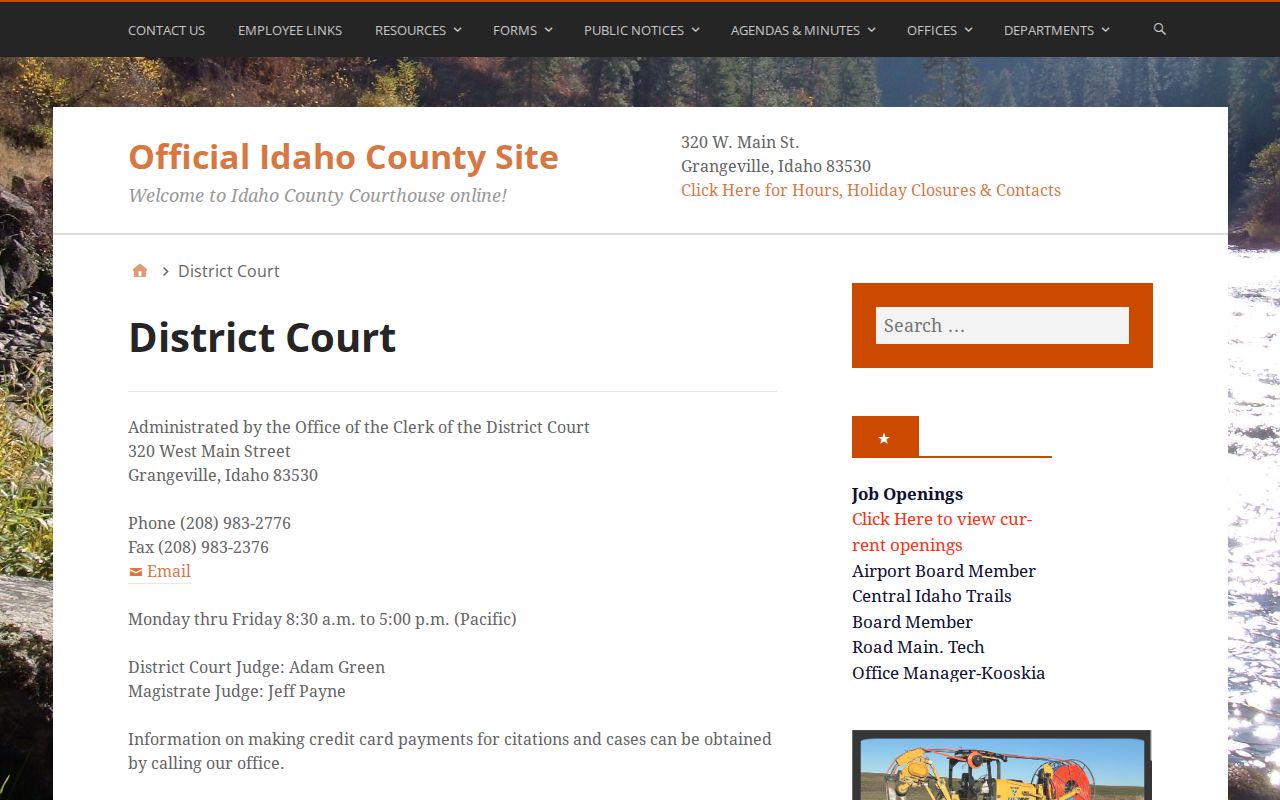
A long trip from a remote part of Idaho County is a good reason to verify that the requested file is public, located, and ready before visiting.
Clerk Custody of Idaho County Cases
The Clerk/Auditor office performs more than a search function. Staff preserves the official court record and certifies copies when a reliable court copy is needed. Certification concerns the document's authenticity; it does not turn an allegation into a conviction or explain the legal effect of an order.
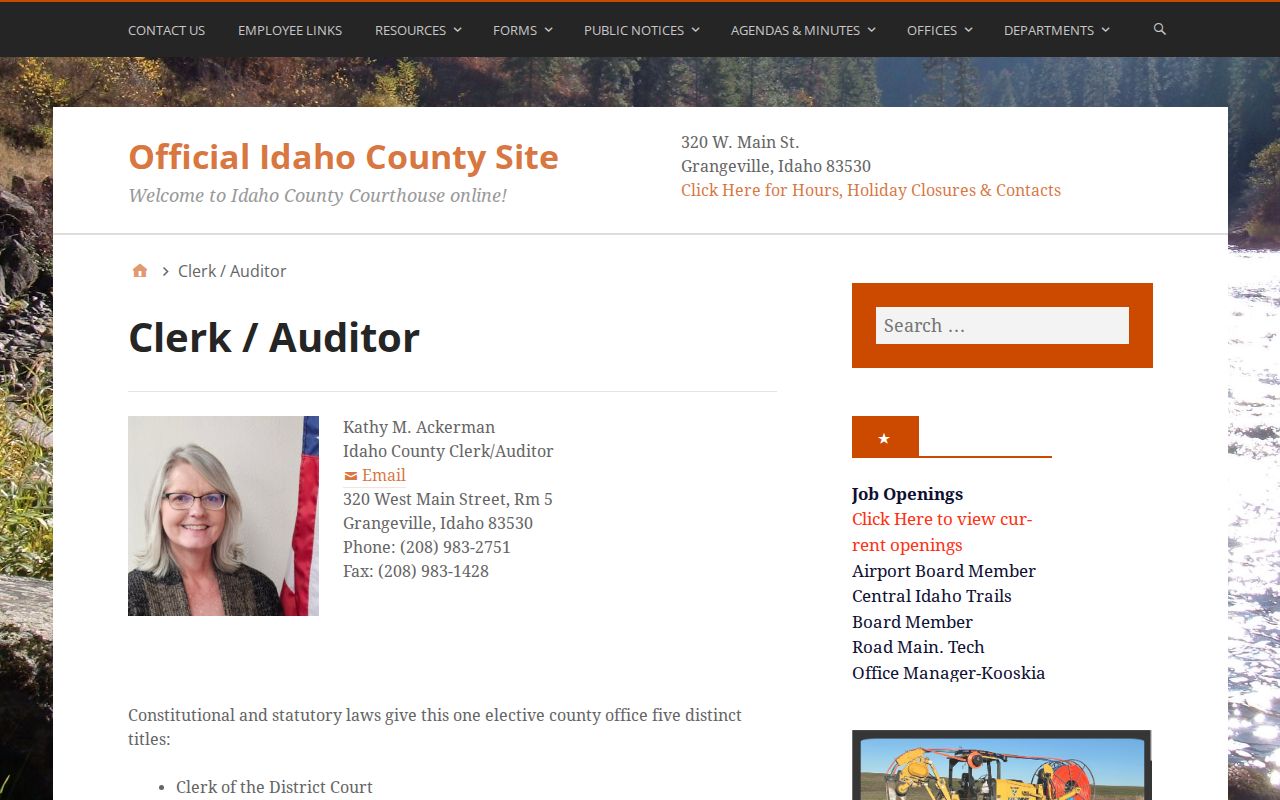
The clerk image reinforces the practical split: iCourt points to the file, while the local custodian supplies records not exposed by the public portal.
Older papers and non-imaged material may require counter or mail service. Give staff the case number, court division, party name, and exact document or date range. A focused request is easier to locate than a demand for every record about a person.
Criminal Case Stages in Idaho County
A local case can begin with an arrest or summons, followed by an initial appearance and release conditions. The prosecutor then controls filing decisions. Felony complaints may pass through a preliminary hearing before an information is filed in District Court. Motions, discovery, and negotiation precede a plea or trial. Judgment and sentencing follow only after an adjudicated or admitted outcome.
Case flow: Charges Filed › Arraignment › Pretrial › Plea or Trial › Disposition › Sentencing
An appeal creates a further layer in the state appellate courts. Supervision records may then sit with Idaho County Court Services for adult misdemeanors or IDOC for felony probation and parole, while the sentencing order stays in the court file.
Idaho County Charging Decisions
The Idaho County Prosecuting Attorney, not the arresting officer, decides which charges to file or dismiss. Kirk A. MacGregor's office prosecutes felonies and the state or county misdemeanors and infractions within its scope. The office also highlights Idaho County Drug Court and victim assistance. A deputy report can therefore describe suspected conduct that never appears as the same set of filed charges.
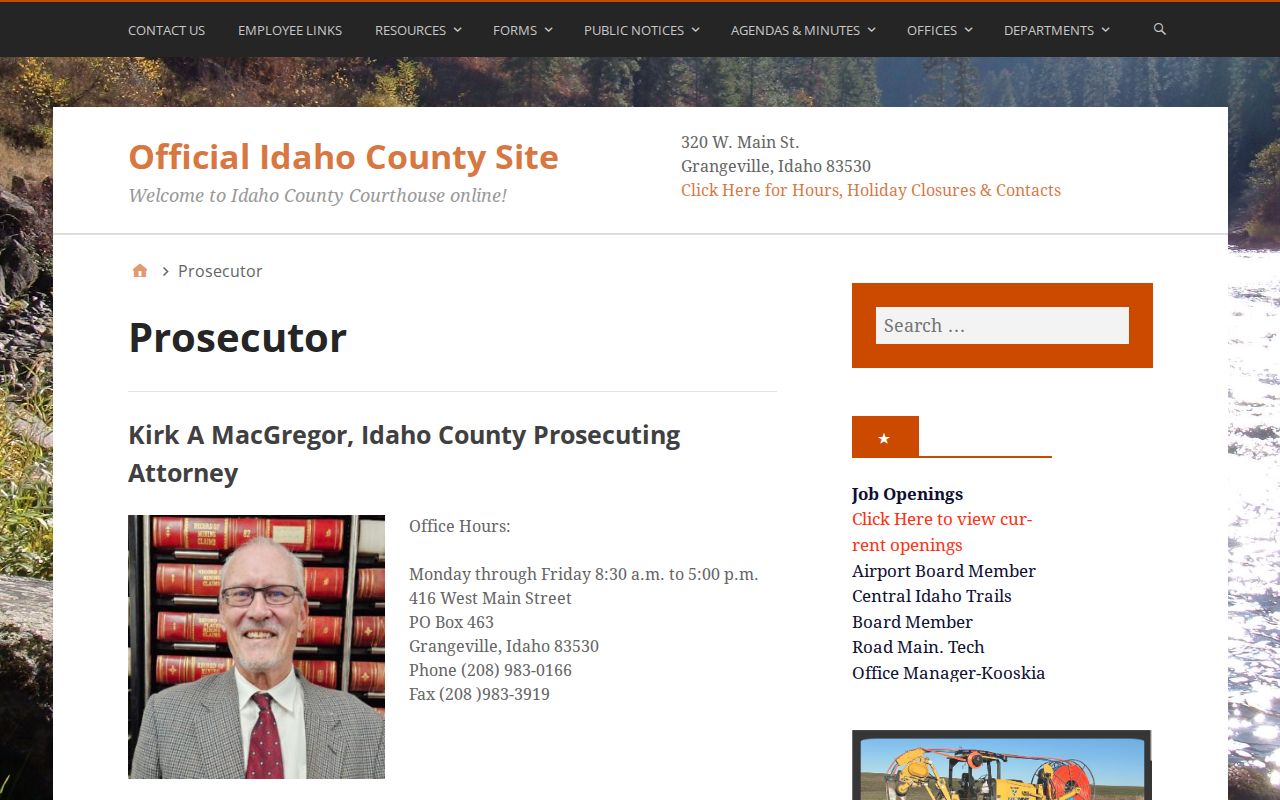
This local source helps explain why the complaint, later information, and final judgment may differ. Readers tracing an arrest into court should rely on the filed docket for the prosecution's actual path.
- Complaint
- The initial sworn charging paper.
- Information
- The prosecutor's formal felony charge after the required process.
- Disposition
- The outcome of one charge.
- Withheld judgment
- An Idaho conditional disposition, not shorthand for never charged.
Federal Court Cases Beyond Idaho County
iCourt does not contain federal prosecutions. Idaho County lies in the U.S. District Court for the District of Idaho, and federal matters use PACER and the federal clerk. Conduct involving federal land, firearms, drugs, or interstate activity can create a federal case even when the event occurred within the county.
The U.S. District Court for Idaho provides current division and filing guidance.
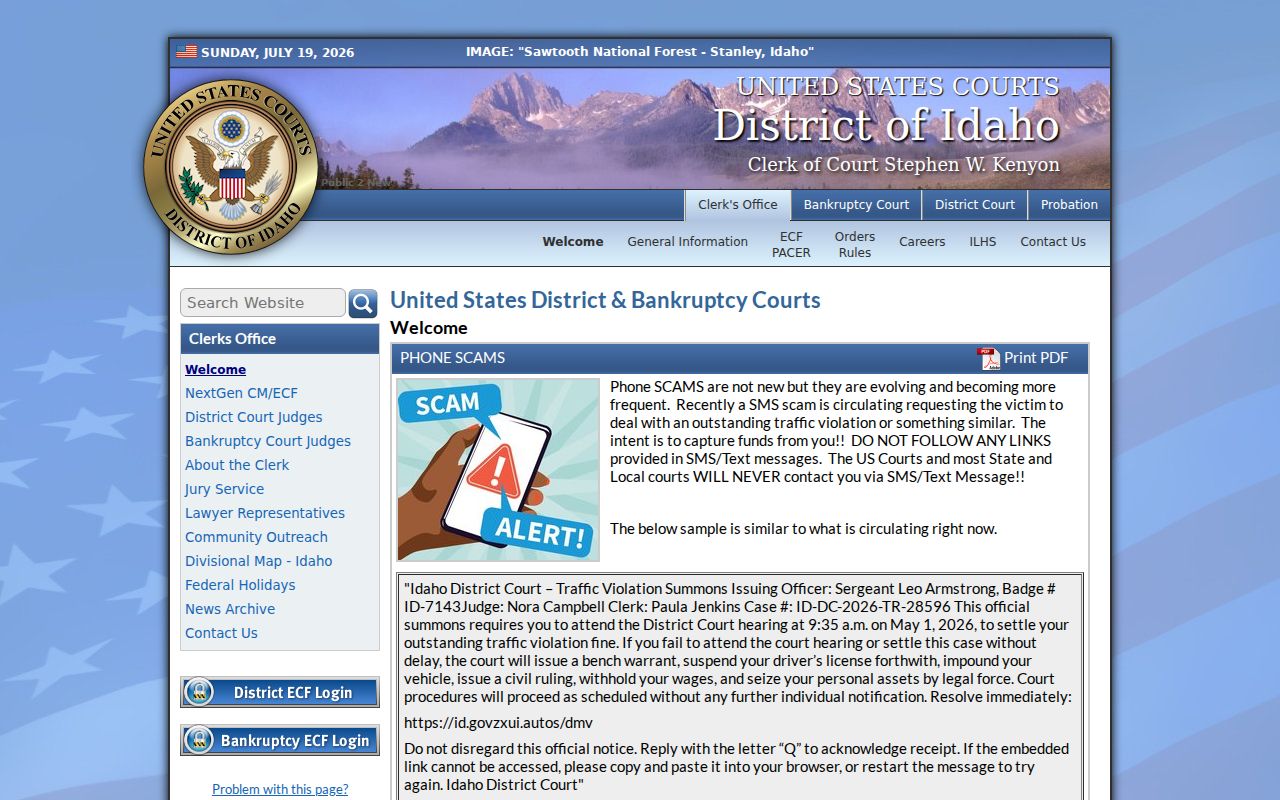
This separate layer prevents a false conclusion that no case exists merely because Idaho iCourt returns no state-court result.
Access Rules for Idaho County Case Records
Idaho court records begin with a presumption of access, but that rule has defined limits. Sealed cases, confidential juvenile matters, protected victim information, exact personal identifiers, and some addresses stay outside public view. Redaction means protected facts are removed while separable public material can still be released. A portal miss can also reflect spelling, timing, older paper files, or a record kept under restricted access.
Ask the clerk whether a public docket exists when a known case does not appear. Do not treat absence from iCourt as proof that no arrest, filing, or restricted case exists. For a broader record picture, compare the court result with the official Idaho repository and the county's arrest search channels, but keep each record type's limits clear.
Relief under Idaho Code §19-2604 may affect a judgment, and qualifying fingerprint records may be expunged under §67-3004(10). Neither label should be assumed to erase every court, police, or private copy. Verify the actual order and then review the court and BCI records that the order addresses.